
Positive Masculinity in Kakuma: How One Man Is Changing Attitudes Towards Gender-Based Violence
Willson Juma grew up believing that consent was not important in relationships and felt entitled to intimacy whenever he wished. Until he underwent a capacity building training by EmpowerVan in June this year in Kakuma Camp, Kenya, aimed at strengthening men’s role in the fight against sexual and gender-based violence (SGBV). He was drawn into the project as he sought to strengthen his violence prevention skills, and being an expert as a community coach made him suitable for the Violence Prevention Program.
“It was a really thought-provoking journey. It made me question a lot of the things I believed in. For instance, I thought it was my right to enjoy sex any time I wanted to. I never cared what my partner would think, or what mood she was in. But this changed after a series of training on consent. I interrogated my culture by carrying out a self-audit on my way of life, and most of the norms and traditions I held to as a human being. It has helped me question everything I do. For instance, I initially would see a survivor of an SGBV case who had escalated the case to the police as someone with a very bad heart and out to destroy the reputation of the perpetrator. Now I even help them with their decision to report and seek help, and even point them to the right organizations. It awakened me, and I can now take action around me. It made me a responsible human rights defender,” he said during an interview
His mindset, he cites, was driven by the practical approach that EmpowerVan applied in its training. Not only did it challenge better practices for the people living in Kakuma Refugee Camp, the largest refugee camp in East Africa, but it also provoked a lot of self-awareness among the participants.
“There is a very big difference in how they teach. We are used to someone coming and teaching us for hours, where we just get to listen to whatever they are saying. I loved how EmpowerVan training was structured, especially in the units. The facilitators were there to guide the lessons, but everything we were learning was coming from our lived experiences as participants. The second bit that drew my attention was the program on self-defense for the ladies. This was a very nice and unique activity, as we often found a lot of GBV cases in the camp. This was mainly because many of the ladies did not know how to defend themselves, as they were not exposed to much training on how to react in case of any event,” he added.
Drawing from his capacity building workshops, Juma started training his fellow men on positive masculinity in the community to be SGBV prevention advocates. This has also changed the way the community, which he has called home for the last three years, now views violence.
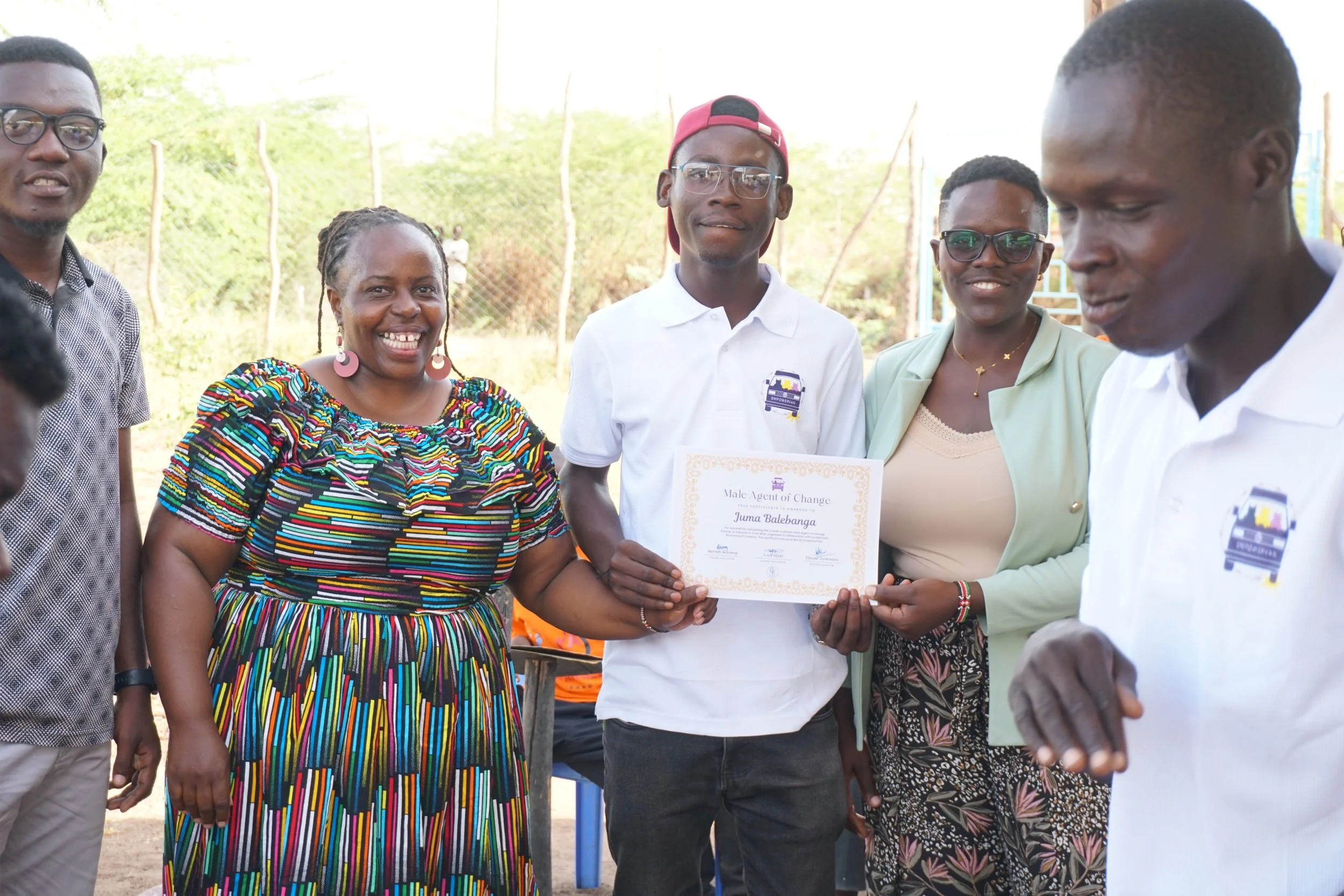
Juma proudly presenting his certificate.
“Initially, the men would see violence as something very normal, but they are now at the forefront of even speaking publicly and in open gatherings about SGBV, which was a taboo topic. They are now the biggest community justice champions we have,” he added.
Juma intends to take the lessons he has learnt from EmpowerVan back to Eastern Congo, his country of origin, once the volatile situation calms down. Having witnessed active war in the country in his teens, which almost saw him forced into being a child soldier, he realizes that the need to protect women in such environments is very high.
“In Congo, there are very few organizations that are advocating for equality, peace and rights, and I want to invest in people the way EmpowerVan has invested in me. I would really like to go back and support/ teach my country's people to leave harmful norms in the community and ensure Congo is safe for everyone,” he adds.
And, for the men out there, his challenge is very simple.
“Do not do anything that you wouldn’t want to be done to you in any way.”